.svg)
.svg)
Understanding AMLR and the Impact on KYC
On 10 July 2027, the EU's new Anti-Money Laundering Regulation (AMLR) becomes applicable across all 27 EU Member States. Unlike the directives it replaces, AMLR does not need to be transposed into national law first.
The Regulation applies directly, creating more harmonized AML and KYC requirements across the EU. The new rules will operate within a more centralized EU supervisory framework, with AMLA, the new EU anti-money laundering authority based in Frankfurt, playing a central role in harmonizing supervision across Member States.
If your organization works with EU banks, you are likely to feel the impact through more standardized and recurring due diligence requests, particularly around ownership, identification data and the purpose of banking relationships.
Key changes
What is changing under AMLR?
AMLR sets more harmonized requirements for how banks and other obliged entities verify and understand their customers. Beneficial owners must be identified and verified, while obliged entities must understand the purpose and intended nature of each business relationship, including its economic rationale where necessary.
Stricter rules for tracing beneficial ownership
AMLR harmonizes how beneficial ownership is identified across the EU. Direct or indirect ownership of 25% or more of shares, voting rights or other ownership interests generally establishes beneficial ownership, while indirect ownership through chains of entities must be calculated across each level of the ownership structure.
More standardized identification data
AMLR standardizes the information banks and other obliged entities must collect when identifying legal entities, including legal form, registered address, legal representatives and, where available, registration numbers, tax identification numbers and Legal Entity Identifiers (LEIs).
This means maintaining accurate and accessible legal entity information will become increasingly important when responding to KYC requests from banks and other counterparties.
How does AMLR change the requirements for ongoing KYC updates?
Customer data must be reviewed regularly, at least once a year for higher-risk customers
Under AMLR, banks and other obliged entities must keep customer information up to date throughout the business relationship. The maximum period between updates depends on risk and cannot exceed one year for higher-risk customers and five years for other customers. Reviews must also take place sooner when relevant customer circumstances change or new relevant information becomes known.
Separately, EU legal entities must keep their beneficial ownership information accurate and current, report changes to the relevant central register without undue delay and, in any case, within 28 calendar days, and verify at least annually that the beneficial ownership information they hold remains up to date.
This move toward more continuous maintenance of KYC information is often described in the industry as "perpetual KYC." If your team still has data scattered across emails, spreadsheets and shared drives, responding efficiently to more frequent KYC requests can become increasingly difficult.
Get ready
How should you prepare before AMLR?
Four steps can help you get ready before the AMLR 2027 regulations take effect.
- Map your KYC data. Get an overview of where your data currently sits and how up to date it is.
- Bring data into one place. Set up a single source of truth covering ownership data, signatories, LEIs, and supporting documentation, so you are not rebuilding the same files for every bank.
- Automate the reuse of answers. Cut down on repetitive manual work and keep your responses consistent across banking relationships.
- Start talking to your banks now. Ask about their AMLR timeline and expected review cycles, so requests do not come as a surprise.
Download our AMLR whitepaper to learn more
%20(1).jpg)
How Avallone helps you get ready for AMLR
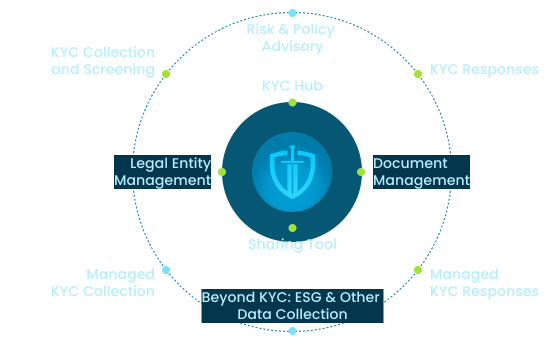
Our platform helps you keep KYC data accurate, up to date, and easy to share across your banking relationships. These KYC tools are part of Avallone's wider AML software.

KYC Collector
automates data collection from your counterparties, including sanctions and PEP screening as well as gathering company data and information on beneficial owners. You get an automatic audit trail and risk scoring on every case, so you do not need to chase documents manually or track everything in spreadsheets.
KYC Collector
- Flexible questionnaires
- Integrated AI
- Real-time tracking
- Smooth collaboration

KYC Responder
handles incoming bank requests by reusing your verified answers across banking relationships. This significantly reduces repetitive questionnaire work, keeps answers consistent, and gives you full visibility into what has been shared, with whom, and
KYC Collector
- Integrated AI
- eSignature capabilities
- Secure data sharing
- Full audit log
.svg)
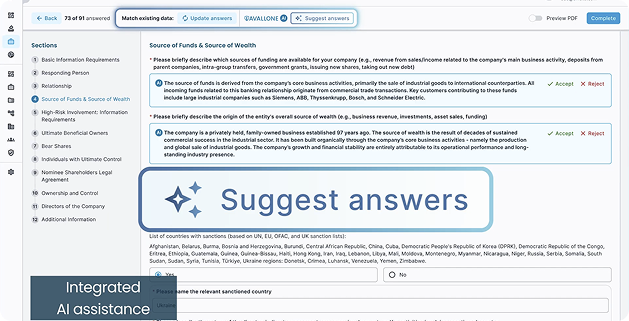
Avallone AI
matches questions from banks' questionnaires with the correct answers from your secure database and continuously learns from the answers you have already given. This means less manual re-entry and more consistency in how you respond across all your banking relationships.
Useful features
- Auto-generated tasks & due dates
- AI-completed KYC questionnaires
- Built-in legal entity management
- Full visibility across AML activities
KYC Hub
gives you one central, always up-to-date overview of ownership structures, signatories, and document expiry dates. Your entire team works from the same information, instead of each department holding its own version.
Useful features to manage KYC documents
- Automated expiration alerts
- Banking-grade security
- Intuitive company structure charts
- Live activity logs
KYC 360° Full Suite
brings KYC Collector, KYC Hub, and KYC Responder together in a single solution, supported by advice from our financial crime prevention experts. You get both the technology and the guidance needed to build a KYC process that holds up once AMLR is fully in force.
Full Suite features
- End-to-end AML & KYC coverage
- All Avallone products in one package
- Seamless module integration
- Single source of truth
Download our AMLR whitepaper to learn more
NEED TO KNOW
Frequently Asked
Questions
When does AMLR become applicable?
The EU Anti-Money Laundering Regulation (AMLR) generally becomes applicable on 10 July 2027 and applies directly across EU Member States. As a regulation, it does not require national transposition in the way an EU directive does. Organizations working with EU banks may therefore want to prepare for evolving due diligence requirements ahead of the application date.
What is the difference between AMLD and AMLR?
AMLD refers to the EU's Anti-Money Laundering Directives, which Member States have been required to transpose into their national laws. AMLR is an EU regulation and is directly applicable across Member States. This is intended to create a more harmonized AML and CFT rulebook across the EU.
Do I need new software to comply with AMLR?
There is no legal requirement to acquire new software to comply with AMLR. However, the Regulation places significant emphasis on maintaining accurate and up-to-date customer information, ongoing monitoring and documented due diligence. For organizations managing high volumes of KYC data, automation can make these requirements and the resulting KYC requests significantly easier to manage.
How often will KYC and beneficial ownership data need updating under AMLR?
For banks and other obliged entities, AMLR requires customer information to be kept up to date, with maximum intervals of one year for higher-risk customers and five years for other customers. Information must also be reviewed sooner when relevant circumstances change or new relevant facts become known. Separately, legal entities must maintain accurate and up-to-date beneficial ownership information. Any change to a company's beneficial ownership information must be reported to the relevant central register without undue delay and, in any case, within 28 calendar days. Companies must also verify that their beneficial ownership information is accurate and up to date at least once a year, regardless of whether a bank has requested it.
Our mission is to empower corporates, funds and banks to seamlessly exchange KYC information through innovative technology and deep expertise.
SMART TEAMS USE AVALLONE TO RUN KYC
.png)

.png)

.png)


Sources
European Union, Regulation (EU) 2024/1624 on the prevention of the use of the financial system for the purposes of money laundering or terrorist financing
https://eur-lex.europa.eu/eli/reg/2024/1624/oj/eng
European Union, Regulation (EU) 2024/1620 establishing the Authority for Anti-Money Laundering and Countering the Financing of Terrorism (AMLA)
https://eur-lex.europa.eu/eli/reg/2024/1620/oj/eng
EUR-Lex, Authority for Anti-Money Laundering and Countering the Financing of Terrorism
https://eur-lex.europa.eu/legal-content/EN/TXT/?uri=LEGISSUM:4776460

.png)